I woke up in the morning with a gentle hangover, and found Estelle in the midst of checking out: she’d gone through all her possessions to find she’d lost her passport. I helped her look, sleepily and to no avail. She had an onward flight to Vienna that afternoon, she told me, which would be fine because internal Schengen flights only require a drivers license for EU residents – but still. We searched everywhere, then gave up and went for breakfast downstairs. She was far more relaxed than I would have been.
Estelle left then for her flight, and we said goodbye and I went back to my dorm to get showered and ready, disgruntled to realise that I now had to find someone else to bond with if I wanted to spend my trip in company. A new guy arrived in my dorm, and I learned he was from London. This is always disappointing, as a traveller – it closes off a lot of conversational options. I didn’t want to talk about London, because I was on holiday, and while on holiday I wanted to be positive and bright – and I struggle to discuss my city without degenerating into a rant. Instead I told him about Estelle and her lost passport.
“Oh fuck, that sucks,” he said.
“Yeah. To be honest, I don’t think there’s an English word for this – shadenfreude isn’t quite right – but I often feel almost relieved when these things happen to other people. You know? Like, usually these things only ever happen to me.”
You know that feeling when you’re talking and you hear the words coming out wrong – sensing the vibe change with every syllable – but you can’t stop? Yeah. I don’t know what reaction I had expected to get from this quip: a laugh, maybe? A little moment of bonding over the helter-skelter nature of travel? A jaded chuckle at how misfortune strikes all of us in turn?
“Poor girl,” was all he said.
Of course I then felt monstrous. The man had only just met me, and the first thing I’d ever said to him was that I experienced relief at hearing a bad thing had happened to someone else. Of course, he didn’t know me – he didn’t know I’d shat myself half to death beside a French lake last year, or that I’d vomited from heat stroke on the slopes of Lake Bled, or that I’d lost both my bank cards in Nicaragua in the space of two days, or that I’d been mauled by a hellhound in a rural Nepali village.
“No, yeah,” I said, wishing I’d just asked him where he lived in London. “Poor girl.”
Having failed to bond, then, I left the hostel to explore alone. The Acropolis was calling to me – it was the only thing in Athens I knew I definitely wanted to see. I’d tried researching a few things to do beforehand, but had quickly got overwhelmed and decided to hell with it – I’d figure it out as I went.
I weaved through streets alternately pretty and grimy, passing through a boisterous market square with a singing man and an old church and lots of pigeons, dutifully following my phone towards the giant rocky hill. You don’t really need a phone to find the Acropolis, to be honest – it’s… there. You can see it from everywhere; Athens’ streets seem to be built in a giant spiderweb around it, so that it looms at the end of every long road, white and crumbling and magnificent. Without it, the streets wouldn’t look like Greece at all – you could be in any of a hundred South European cities. The sight of it gives a wonderful sense of place.
I passed by some ruins – the Library of Hadrian – but I didn’t linger long because I didn’t want to use up the finite amount of my awe on lesser constructions. I wanted to save it all for one big punch at the top of the mountain. I passed the Roman Forum and skirted the Agora, took a couple of photos on my film camera, then hustled on up the hill.
It was all free, that day – all the ruins and museums in the city. I don’t know why; it didn’t matter much to me. The key thing was not to pay. The Acropolis usually costs €30, and the adjacent museum is €20. I passed a guy sitting beneath a tree playing some strange Greek bagpipes, and watched a tourist group duck and weave around him, filming on mobile phones. Someone asked me for directions – which way to the Acropolis – and I pointed up the stone path, winding skywards.
“You can probably get up the hill both ways,” shrugged the man, who immediately set off in the opposite direction for some reason.
A little higher up the path there’s a gigantic boulder you can climb on. I tried to read the plaque beside it to understand what it was, but the writing was scientific and bland – lots of dates and names of dynasties and archeological measurements. Over the coming days I was to find this the case everywhere I went – none of the information on display was particularly riveting. I found it odd; surely the visiting masses would be more intrigued to know what happened in these places – who once stood there, what they did, the impact it had, the stories – rather than their precise heights and widths. If you asked your mate about his new girlfriend and he started reeling off her shoe size and A-level scores, you’d throw a glass of water over him.
I was taking my time getting to the top, savouring it. It’s like when you get served a delicious meal; it seems a shame to eat it all in one chomp. So I rounded the hill very slowly, sitting on benches here and there, taking photographs and people watching.
At the entrance there was no queue; I suppose with it being free, there was no fannying about with card machines and change. At the ticket office I barely opened my mouth – I’d hardly made it through ‘hello’ when a ticket was thrust into my hand.
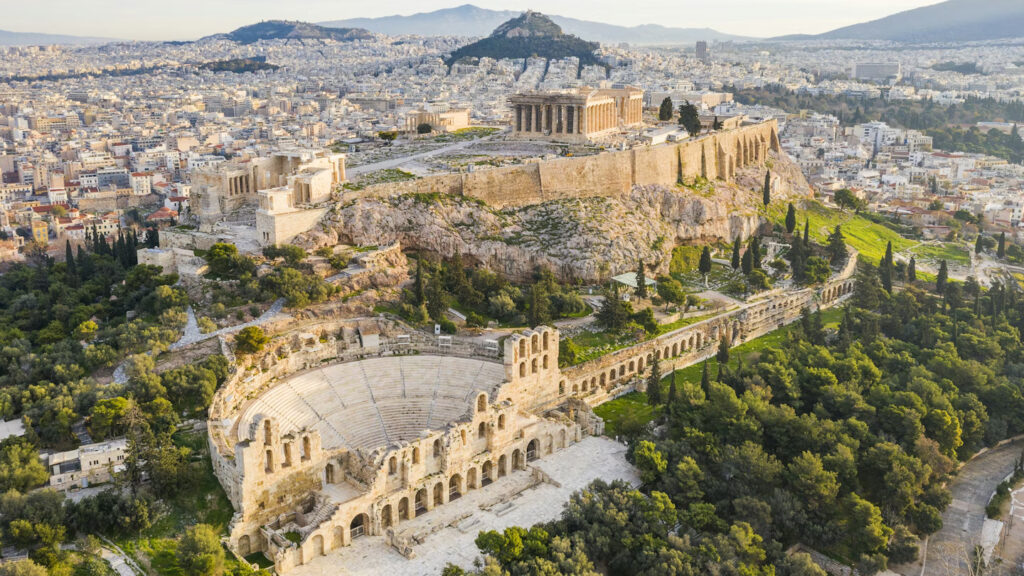
Olive trees and rocky stairs leading upwards. My first stop, which came upon me out of nowhere, was a vast amphitheatre cascading down the hill to my right. I stood at the top, along with 100 other people, and gazed at it – at the marble steps, the tiled stage, trying to visualise it filled with ancient Athenians, listening intently to a passionate speaker. I couldn’t do it – too much noise, too many languages, too much jostling.
Then I had an idea. I took my headphones from my bag, and on Spotify searched for ‘Greek music’. I chose the first playlist and pressed play. It was a song called ‘Zorba the Greek’ – a twangy, folksy, plodding tune that slowly increased in speed and intensity. I recognised it from somewhere. Immediately everything felt very Wes Anderson and twee, and also, with the song’s ever increasing speed, immensely anxiety-infused. The crowds around me seemed to move faster, the people more irritating, and I felt my eyes widen with sudden panic. Who the hell was this music for? No thank you.
Switching playlists, I tried one called ‘Ancient Greek music’, which was just an ominous drum and strange howling noises and made everything even worse. Nope. Finally, I had the brainwave of queuing up to the soundtrack to a video game I played a few years ago, set in Ancient Greece – Assassin’s Creed: Odyssey.
The shift was instantaneous. Jangling foreign strings, tender and light over a slow throb in the background. Yes – yes. This would do the trick. Suddenly enthused, I began the final stairclimb to the Acropolis, and the Parthenon. The stairs swing you off to the right, then plunge you back around without warning. You skirt a cliffside, and suddenly, from nowhere, a vast gate appears before you – flanked by tall cypress trees and incredible white columns, staring outwards over the bay and the city and the mountains like the door to Olympus itself. By pure luck, at this exact moment, the song in my ears hit full stride: a chorus of mandolins and drums and soaring, echoing strings. It stopped me dead.
Weaving left and right, scores of tourists were climbing the steps towards the mouth of this imposing white gate – through which I could see only blue sky and curling clouds. But with the soar of the music, they were not tourists at all – it dawned on me, all at once, that beyond the clothing, this is exactly as it would have looked 2500 years ago. Humans, young and old, toiling to ascend the steep marble steps to worship at the hall of their gods.
I climbed the steps in great steep strides, and passed beneath the gate in a state of quiet shock, as though under a spell. And there, the Parthenon – a great marble temple, the oldest structure I have ever seen, looming still from time immemorial. A choir leapt into the chorus in my ears, singing in a language I didn’t understand, and as I turned to look out over the vast white city with the sparkling sea beyond, I felt everything – in a flash, I could see it: beacons burning in iron braziers, soldiers standing stoic with spears at their sides, faraway wooden ships in the harbour, politicians hitching their robes to take the great high stairway into the temple, and the towering golden statue of Athena therein, staring down with fearsome eyes. The majesty of it – the power.
I felt, for the most ephemeral of moments, that I was not merely some tourist looking at a collection of pretty pillars – but a living part of history, flowing before and after. I had climbed the same Socrates would have climbed, and Alexander the Great – the same steps the Persian immortals climbed when they burned and ransacked the city – all of that time, of warring factions, of power rising and falling and rising like a tide, and it all happened right here. I was not separate from history, some other entity leafing through an old book – I was in the book – and if I stood stock still and rolled back the years, I’d have seen it all play out, all the way back and all the way forward again to the second my own feet trod that great rock. I’ve stepped inside many a cathedral and felt a sense of awe – of some strange, tugging belief – but never before had I been hit full in the face with it. Of course ancient people held such incredible faith. How could anyone believe the inspiration for something like that came from anything other than a god?
The hairs on my arms stood on end. In that moment, only for a second, I believed in the whole damn pantheon.
The song finished and I started it again – I must have played it five times in a row on that rock, sauntering around the outside of the temple to see it from every angle – but you only get one great punch of emotion like that per day. The returns diminished, and the mirage did not return; the magic was finished, and all around me was a ruin once more.
I took photos, and asked strangers to take photos of me. I spent an hour wandering the Acropolis, straining to return to the state of insane holy wonder I’d experienced upon my arrival. I could hardly believe what I’d felt – the depth of it, the great, heart-soaring lift. For the rest of my time in Athens, I told every traveller I met to try the same thing: to queue the song, moments before turning that last corner. I don’t know whether anyone did – but I hope so.
I left the same way I came, through that incredible gate, watching the great unfurling sweep of the city below, rolling away into the mountains. I followed a path downhill, crossing ancient courtyards, and found a wide road that led me to the Acropolis Museum. I spent only thirty minutes inside; it contains shattered statues taken from the hilltop, moved down and rehoused in recent years, but I’d already had my awe-gasm, and I could feel another wouldn’t be coming along any time soon. But it was alright: one was quite enough.
Outside the museum I sat down to smoke, and after no more than fifteen seconds, an old man came and sat beside me. He asked me for a lighter, and I obliged.
“Where are you from?” said the old man.
“England,” I said, a little guiltily – the Acropolis Museum is filled with angry plaques detailing the theft of the Parthenon’s greatest marble statues by the 7th Earl of Elgin, which are now housed in the British Museum and we bafflingly refuse to give back.
“England, very nice,” said the old man.
It was early in the conversation, but already I knew where this was going. I’ve been accosted many hundreds of times by now, from Kathmandu to Havana. The conversation would turn to money, or prostitutes, or he’d invite me to a discotheque. Still, I didn’t want to be impolite.
“Where are you from?” I asked.
He told me he was Italian, though he lived in Dubai. He was apparently 55 years old, though he looked about 80, and he had seven sisters and a puppy and his father was dead but his mother was still alive and he loved her and she was looking after his dog while he was travelling. He was wealthy and had been to Athens seven times and had travelled to every country in Europe.
“How lovely,” I said.
“Yes,” he said. “Me, I am aeroplane engineer.”
I found this hard to believe at face value; he was quite unkempt and he had long fingernails, and aside from this he seemed completely bonkers. He spoke faster than I could understand, switching at random between stories like an escaped dog leaping between snack bowls in a picnic. He grabbed my knee at intervals, when he wanted to emphasise a point. Any time now, I thought. Here it comes.
“Yes, aeroplane engineer for a long time. I work on the ass of the plane.”
I thought I’d misheard him.
“Yes,” he said. “The ass. The other engineer, he works on the front of the plane. This is the pussy. And the middle, the titties.”
I laughed, in shock at the accuracy of my internal freak-o-meter. Never fails.
“It’s like this place,” he said. “The Acropolis is the ass, the Agora the pussy.”
“Which bit is the boobs?” I asked.
He laughed and slapped my thigh.
“I like you. You want to come to Rome one time, I find you the best girls. Whatever you want. You want virgin, older, two girls, anything, I find for you. You my friend. You want to go for a drink?”
And there it is.
He picked up the pace here – rambling and switching gear so fast I couldn’t follow what he was saying. When I finally zoned back in he was talking about the best way to ride a camel. I could have just stood up and walked away, of course – but not once, of all the lunatics I’ve met, have I ever left early. I just sit there and wait for them to run out of steam. And of course, if I stood up to leave, there was always the chance he would totter alongside me. I couldn’t be bothered with the guilt of speedwalking away and leaving the strange old man in my dust – hearing his confused howls behind me – ‘I thought you my friend!’ – so I decided to simply wait until he tired himself out.
After twenty minutes, he stood up and wandered off, whistling at a distant golden retriever he’d seen. When he was safely gone, I raised my eyebrows, sighed, and set off in the other direction.