Now, at this point in these dairies I couldn’t blame you if you’d quietly begun to wonder whether we got drunk every single day of the trip. Well – more or less, yes. But not really on day five, which is the day I’m writing about now. No: day five was one of culture. With just a smattering of boozing.
So: I don’t know what we did in the morning. It was two months ago, I can’t remember. We probably did what we always do, which is lounge around in our pyjamas playing video games and eating crap, me vaping lavishly and Annie smoking blunts and/or bowls. Back in the day I used to smoke these with her, but I’ve come to prefer my mornings a little more crisp. Daylight is for clear thoughts, darkness is for wavy ones – that’s the way I like it best.
At precisely 3pm – I know this because that’s when my photos of the day begin on my phone – we arrived off the train in Manhattan. Given all the boozing and tear-arsing around over the previous four or five days, we can safely assume that I would have been both shattered and brain-fogged at this point – which naturally led us to decide it would be a nice idea to spend several hours wandering around the MoMA: the Museum of Modern Art.
“You know, I don’t think I’ve ever been in an art gallery not hungover,” I said to Annie as we browsed the paintings. “Just once I’d like to look at some paintings and not be feeling like death.”
Annie is a good person to go to art galleries with because she knows a lot about art. I, by comparison, know very little. I can recognise a few dozen famous paintings, probably – I know a tiny bit about a couple of different eras and art styles and whatnot – but that’s really it. Annie is clever about it. She’s a true believer, which is an energy I like being around even as I lampoon it. I like how sincerely Annie describes things she likes – a good wine, a painting, a song. She has a colourful and varied vocabulary and she’s able to bust out whole monologues at a second’s notice, and it never sounds contrived. What’s even more impressive is that she never sounds pretentious either, even while explaining the value of, say, Piet Mondrian’s art, which to me of course looks like an unspooled gaffa tape. She just believes wholeheartedly in what she’s saying – and it’s one of my favourite things about her.
Growing up where I grew up, there’s a tendency to laugh at certain kinds of art, to blow a raspberry at anything too lofty, too avant garde. Take us to the ballet, and Northerners don’t perceive an artist on the stage, let alone a dying swan – they see a man in a tutu prancing about and getting paid millions while the rest of us have to go to work. But when I listen to Annie talk, I can escape that mindset – because I do believe it’s a shame to close oneself off like that. It’s almost a relief, then, when I listen to her talk and I find myself once thinking: Hell yeah.
We saw paintings by Picasso and Gustav Klimt, and Annie explained to me, upon seeing my raised eyebrow, the importance of Marvel Duchamp’s work in the context of the period it was created. I stood in front of Starry Night by Van Gogh for a long time. It’s a very beautiful painting, and more vivid in real life than any photo can show. I wanted a moment alone with it – felt entitled to it somehow, as though I had some innate claim to ownership of it simply because it has always resonated with me on some hard-to-articulate level – but of course, everyone feels that way. That’s what that crowd consists of: a hundred people jostling for a moment alone with a painting that feels like ours. I feel a similar sort of way about the Beatles’ music, or Tom Hanks’ face.
In the next room from Starry Night I found what might have been my favourite painting of the gallery: one I’d never seen before, named ‘Mme Kupka Among The Verticals’, by Dutch artist František Kupka. More than any of the other works I looked on, this one held me. I saw a young woman drowning in a sea of shades, overwhelmed by the constant spread of her states – her ecstasy and her sorrow and her silliness and her guilt and her love and and her shame and all her longing, all of it lumped together, too much for anyone, mounting and rising around her.
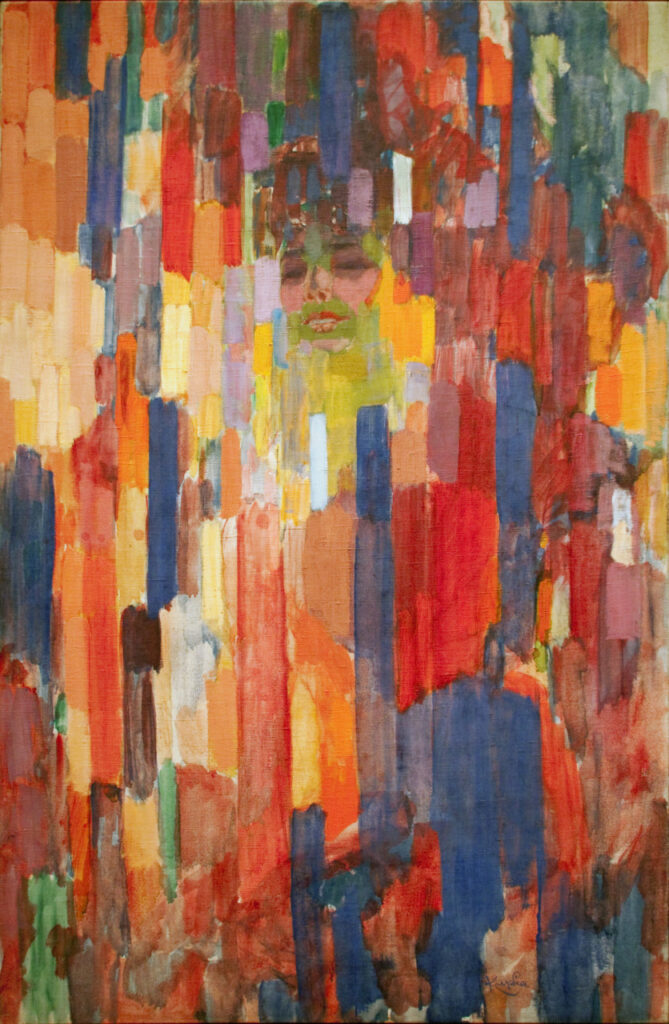
I looked at Water Lilies by Monet and La Danse by Matisse, and we stood together before a gigantic Jackson Pollock board covered in black and white paint, and I was surprised to find I quite liked it. We spent another hour or so exploring, then I felt myself growing grumpy due to lack of food, so we left to get a snack in the street outside, passing through a green park en route to our next stop: The New York Public Library.
It turned out to be a very brief stop, because the library’s main atrium is closed to tourists – you’re only allowed in there to study.
“If you really want,” said the information desk helper we asked, “you can go in and just pretend to read your phone for 20 minutes, then leave.”
I was genuinely up for this (I really wanted to get inside) but Annie said it sounded like a very dumb way to spend our day – so we left, and crossed the few blocks to Grand Central Station, another landmark on my list. The cavernous train station looked – well, it looked exactly as I thought it would look, given that, like everyone else in the world, I’ve grown up seeing it in films, music videos, artworks and TV shows for my whole life. I could have happily sat half an hour in the grand foyer, staring around, but we had places to be.
We zoomed downtown on a train and wound our way past Ground Zero. I’d visited the site of 9/11 previously, back in 2014, and I was surprised to learn that Annie had never visited.
“Whoa,” said Annie, as we stood and read the names around the great inverted fountain.
We talked about 9/11 as we crossed the square – where we were when we heard the news, how our families reacted – and I looked up at the Freedom Tower, gleaming against a blue sky. 25 years ago. How strange that for children born today, 2001 will be as far from their birth year as 1968 is to mine. Just – another era entirely.
We were on the way to meet a friend of Annie’s, Toni. In her early to mid 20s, Toni is a Chilean singer and songwriter employing Annie to help produce her new album. She lives in an expansive modern flat overlooking the Hudson River, and my first impressions of both Toni and her apartment were the same: blimey. She had an aura of health and vitality about her, and eyes that were at once lively and demure. Even better, she immediately suggested we go to the rooftop and smoke a joint.
The three of us sat up there for a long time, chatting twenty storeys high among potted trees and plants as the sun sank low and sparkled on the river. I floated off whenever the girls got too deep into music talk, only zoning back in when someone addressed me.
“So do you like New York?” asked Toni.
“I do,” I said. “Especially Greenwich Village. All that Bob Dylan, Beat Generation stuff.”
“Do you think it’s still got the same atmosphere, though?”
“Well, I wasn’t there the first time around so I wouldn’t know.”
She had a point, though. I’ve been doing a lot of nostalgia chasing, recently. When, I wonder, am I going to start looking forward? It’s odd, isn’t it, that all my heroes are so dusty, so dead, when all the people that inspired them were their contemporaries, pushing at the boundaries of what was doable. They were inventors – all of them. They sought to create something new, not to salute endlessly what had gone before. I really ought to start moving that way myself, nowadays – seek out the forward-thinking, the new, the genuinely never-seen-before. And, well – more to come on that front in time. Suffice to say, I’m working on it.
Back in Toni’s flat, the girls planned their upcoming gig together – set times, song lists, that sort of thing – while I looked around and got my feet scratched at by her green-eyed cat. We all went for tacos after at a nearby restaurant. We ended up talking about art; Toni ended up giving Annie and I an impromptu speech about how important it is to give everything you’ve got as an artist, to never give up, to make sacrifices, to push further than other people do. It made me smile in a quiet, internal way; I remember giving many such speeches when I was her age. I still do, occasionally – if I’ve had enough wine.
Annie and I went home after that, weary from several days of running around. We watched a movie on the sofa – Step Brothers, I think it was – and fell asleep.