Well I woke up and it was my thirty third birthday – a few texts from friends, a couple of cards to open I’d brought with me, and when Annie woke up we had breakfast and I watched TV on the sofa while the girls got ready.
I felt good at first, waking up, but found myself growing progressively quieter as time passed – not that Annie and Tayler noticed, occupied as they were with their usual morning routine of flirtatious bickering as they weaved in and out of the bathroom and kitchen. Birthdays, man. They always get me weird. I’m a sentimental person in all manner of directions, and birthdays just seem to prick me – the one day of the year where you want everything to go your way, for everyone to fawn over you and listen to you and laugh at your jokes, to allow you the lead on every decision. It didn’t take me long to pinpoint the origin of my sadness: I hadn’t got a particular birthday text I’d been anticipating. One of those texts from special people you don’t hear from very often anymore, you know. As I showered and attempted to sing myself happier, I found myself feeling weighed down.
Outside the apartment in the Brooklyn street – Tayler had left already for work – I stood on a concrete corner and told Annie I felt sad. She asked what was wrong and I told her, and in the heat of a sunny New York afternoon I cried, first only a little bit, then all at once, and Annie hugged me for a long time and I rested my head on her shoulder. I’ve always been surprised by the warmth in Annie’s hugs. All that bravado and cockiness, but when she hugs you, she means it. I wiped my eyes, apologising for getting upset, and she said it was okay and that it was gonna be a great day, and we went into a store to buy Coca Cola and chocolates.
We took the train to Manhattan, talking freely about lost loves and what it means. The day would be another great bar crawl, Annie revealed, based around Beat hangouts and counter-cultural hotspots. She’d planned it all, each bar in turn, followed by tickets to Cafe Wha in Greenwich Village, where a young Bob Dylan played his first ever show. More than that, she’d gathered iconic photographs of Kerouac taken around the city, intending that we recreate them as we crawled along. I was very happy.
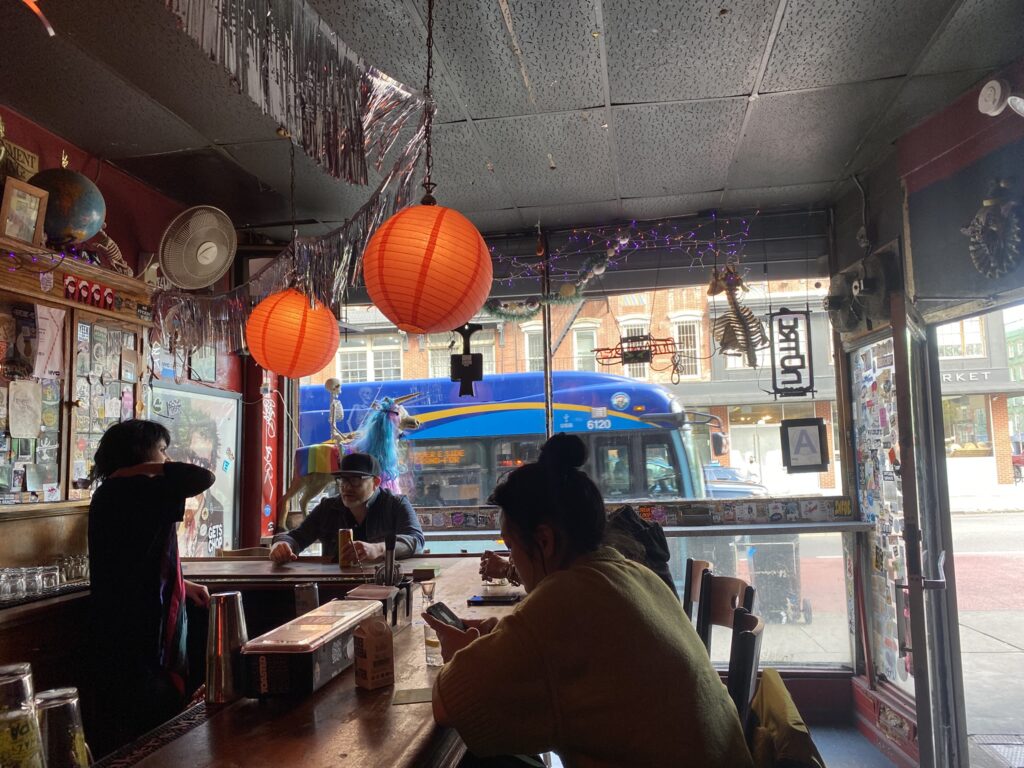
We stopped off first at a dive bar Annie used to drink at in college. We just don’t have them like that in London – a million pubs, yes, but there’s something about dive bars that just relaxes me. Dust everywhere, scrawling on the walls, toilets with broken seats hanging off and stickers galore – I feel I can unwind, that I’m welcome, that it doesn’t matter what I say or wear, or how I sit. There’s always guitar music playing and the bartenders have tattoos and dyed hair, and the chairs don’t match and the bartop’s a little sticky, miasma of liquor in the air – you feel creative in those places. You want to pull out a map and start planning a revolution.
We sat at the bar and got ID’d, and as I handed over my passport I told the bartender to check the exact date.
“Oh,” she smiled after a minute. “Happy birthday!”
“Thank you very much,” I said.
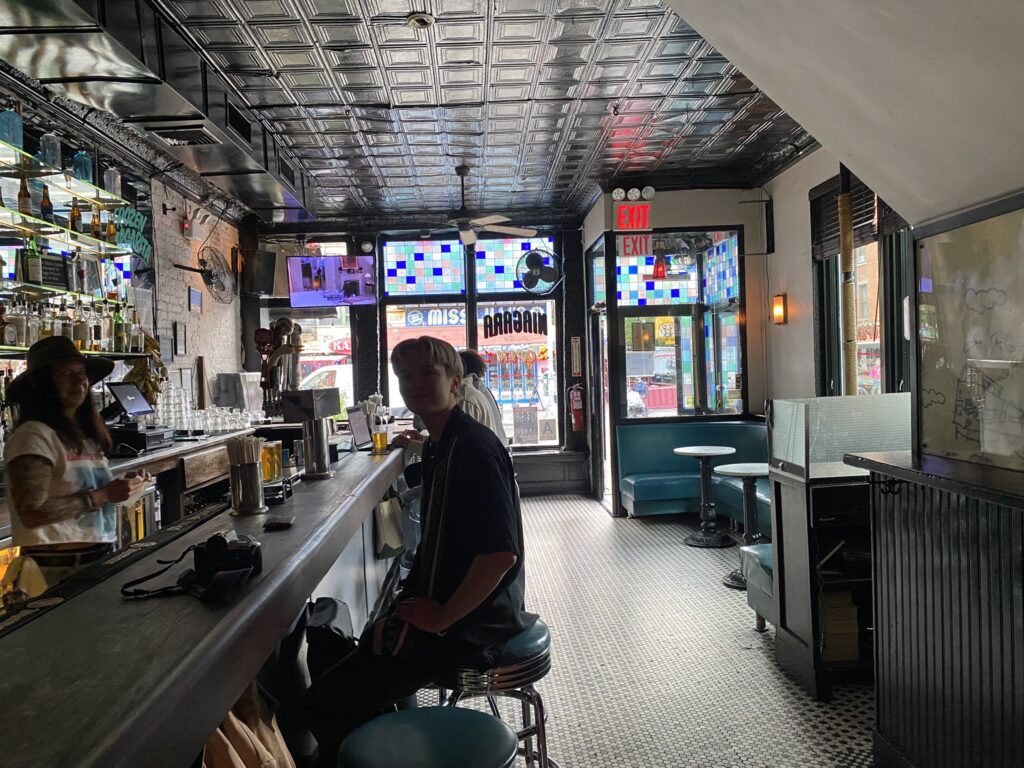
I loved that first spot – grungy and dishevelled – and could have stayed there hours, wittering and fixing the world with spiralling chats. But we had plenty else to see – and we took off to our next hub, Niagara. I’d no conscious knowledge of this bar, though I must have read the name a hundred times in Beat literature without it sinking in. If you search Google images for Joe Strummer, lead singer of the Clash and a hero of mine, you’ll come across a picture of a mural: Know your rights! it says, beside The future is unwritten, Joe Strummer, 1952-2002. I’ve known that image for years, but never wondered where the mural might actually be. Well – it’s on the wall of Niagara.
I stood and photographed it, feeling as though I’d seen a celebrity, and Annie showed me photographs she brought up her phone – again, iconic shots I’ve known for years: Jack Kerouac pulling a face beside a statue in a park, and another of him side on, gazing through a bar window. These, again, were outside Niagara. We recreated the shots – or attempted to, I don’t have half the side profile he did – then went in for drinks.
The bartender liked us, and we sat at the bar and chatted jovially about England and artists and nonsense. We stayed for two, enjoying ourselves too much, and clambered in a photobooth at the back wall, sharing one little seat for a reel of snaps with our arms around each other’s shoulders.
I think, funnily enough, given how much I rave about her, that I often have walls up around Annie. The intensity and rapidity of our first bonding when we met in Berlin nine years ago caused me to realise it’s possible to like someone too much, to lean too heavily. When we first met, Annie was grieving a loss in her life. She was in the midst of her darkest period to date, clad in black, mourning and experimenting and trying to figure out how to feel okay. I knew nothing of grief at that time, and like a labrador I only wanted to hang out every day and run around and play, throwing glitter everywhere. And there was a lot of joy – but I realised, as the months passed, that where I was a dog, Annie was a black cat. And, like a cat, her moods could change based on things imperceptible from the outside. Often I was clumsy with my words, too assuming and expectant, drunk on the dizzying joy of this new, strange friendship – and often, in those days, I found I’d crossed a line without realising. Annie needed space, often – whereas I wanted every minute of my life to be crammed full of people, conversation and noise.
And so I learned to hold back a little. I was in awe of her – I still am, of course, but back then it was on another level – and I realised that in order for our friendship to work, I had to rein it in. I learned her boundaries, stopped pouring my heart out after a few drinks, stopped expecting more from her than she could give. I didn’t want to scare her off – to startle a cat with a misjudged embrace when it just wanted to be left alone. It would be on her terms, I decided – and it wasn’t a hard decision; she was worth it. When she was ready to hang out, I’d be there. If she couldn’t do it – I understood.
What I never expected, however, is that in the years that passed we would cross like ships in the night. Annie processed her grief, ended a bad relationship and moved back to the US, and as our yearly adventures progressed, I noticed a change in her. She dresses louder – more colourful. She’s sillier, goofier, more whimsical. Her mental health is robust. She’s happy in her career, in her relationship. And you can feel it – the playfulness, the eagerness for fun and mayhem. The darkness, though some may still remain, has receded enormously.
I, on the other hand, have had a difficult few years. Since Covid, really, I’d been on a steady downward trajectory. I experienced struggles with alcohol, failed relationships, and the monstrous guilt born thereof. My career floundered and sank, and I became lost and adrift in life, unanchored and uncertain. Annie and I – our roles reversed, almost completely. Suddenly she was the one with the rainbow disposition, and I was the one with eye bags, tired and misanthropic.
Annie tells me she loves me pretty freely, these days. She says it on the phone, by text, walking down the street, in bars over drinks: I love you so much, dude. I’m so glad you’re here. It’s been years, and it still takes me by surprise. She feels safe in saying it now, whereas I have some un-learning to do. With a whole year passing between each time we see each other – and with the struggles I’ve had in the intervening time – it takes me a while to warm up when we meet now, to feel safe enough to say it back, especially remembering the Berlin days and how I had to get a handle on myself.
It’s very precious to me, when we talk to each other like that. As a male, this kind of friendship is exceedingly rare, to be found only in storybooks. It’s so precious to me, in fact, that I get nervous of how vulnerable it makes me feel, and I find myself speaking with a certain silliness, a semi-detached cynicism, some ironic offshoot of sincerity. I can only say ‘I love you too’ if it’s followed by the words ‘you dick head’.
I’ve found, each time we’ve met up over the last few years, that those walls of mine come down slowly. It used to take hours, maybe a day – but this time it was longer, due to, I suspect, my rather threadbare mental health at the time of my visit. I can always sense it when it happens, the walls coming down – that tonal shift, away from simple catch-up conversation and towards sibling-esque idiocy; the language takes on a new form, the chat meanders wildly and breezily. I find myself relaxing, finding our groove again. And that’s how it was on my birthday, taking daft pics in the photobooth: Ah, I realised, we’re back in it.
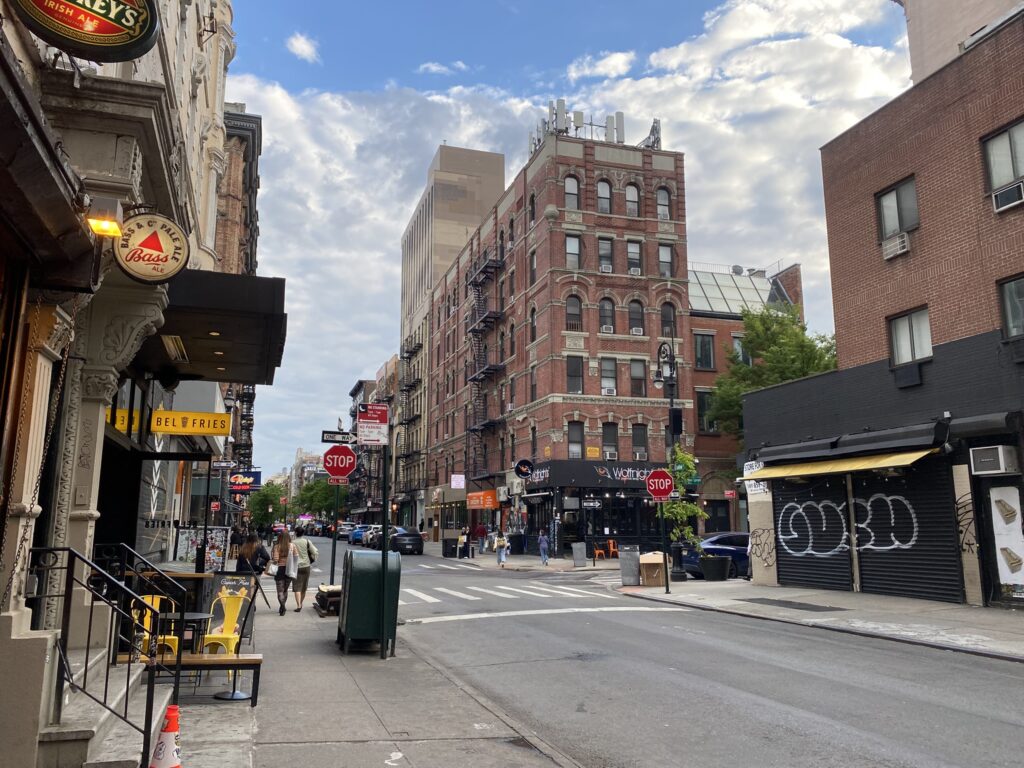
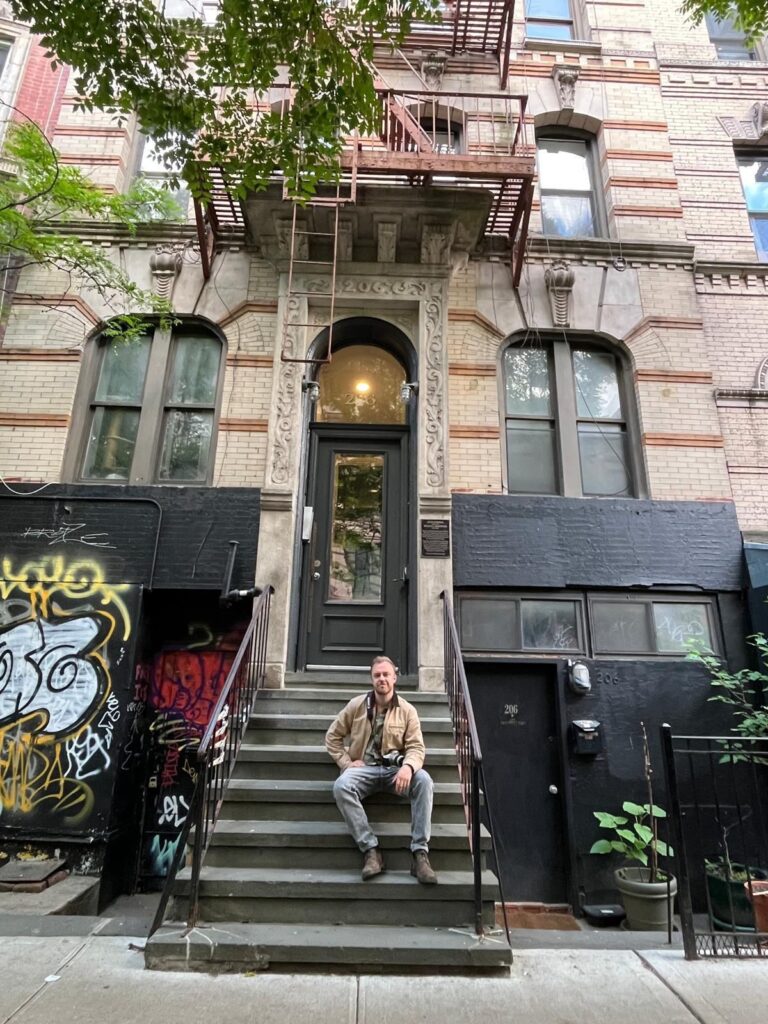
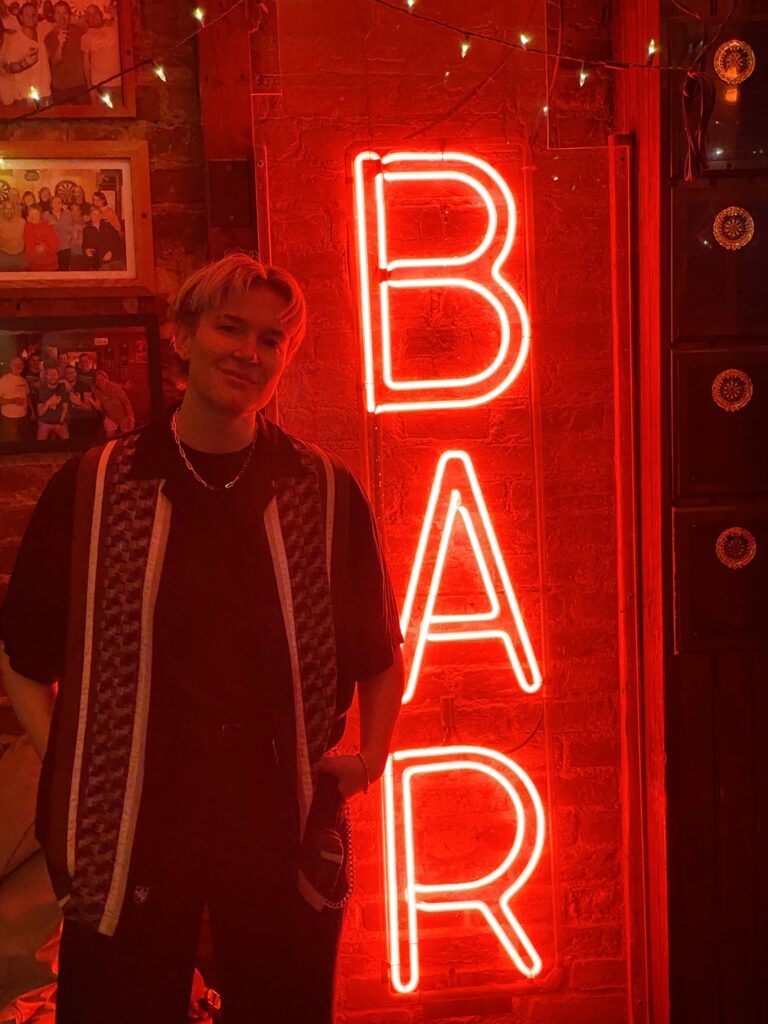
We walked down the street – stopping to hug a tree, because Annie told me she’s never done it and I said it feels amazing – and visited Allan Ginsberg’s old apartment. I took a photograph sitting on the front steps. Then onto the next bar: another bluesy saloon where a New York couple complimented my camera and bought us whiskey chasers. Then – blurrily – over to the Village and the Stonewall Inn, though we didn’t go inside. Instead we stopped to drink at the Kettle of Fish, another Beat boozer with a neon ‘BAR’ sign outside that Kerouac was photographed beside in 1959. We took the same photo, but didn’t stay longer than one drink, as the place that day had a sportsy, bro-ey atmosphere that neither of us could be bothered with.
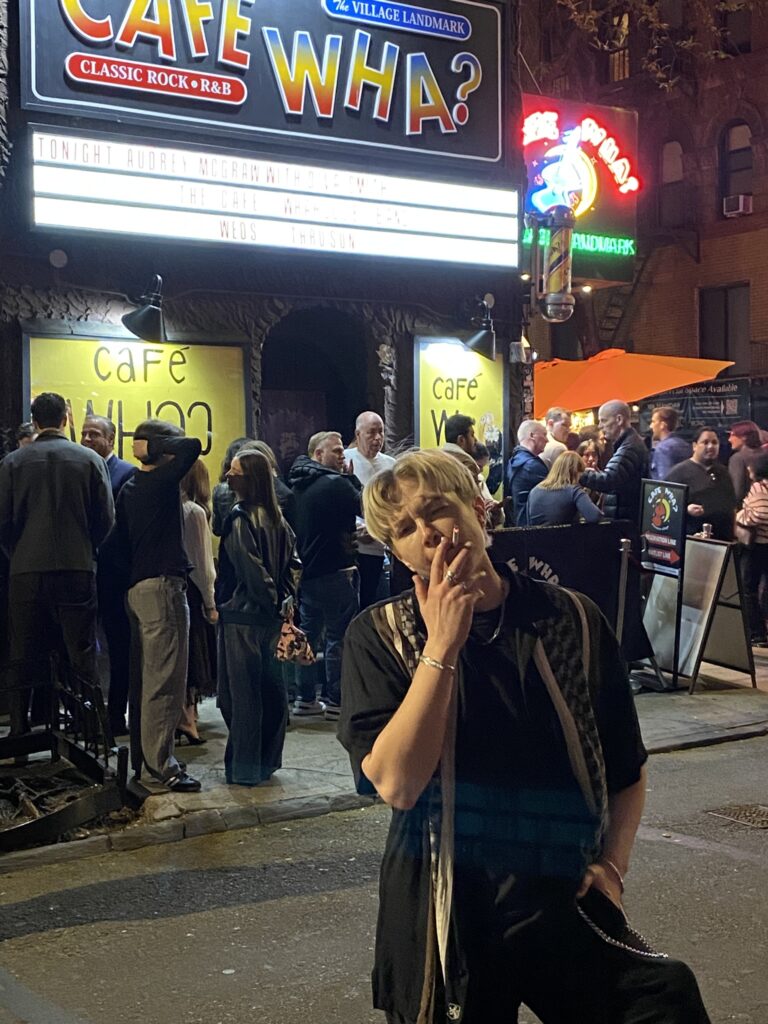
One more Beat bar – White Horse, I think it was called – and then onto the basement bar Cafe Wha at 9pm, for live music and Coronas brought to our table. I imagined the decor and general atmosphere would have been rather different in the 60s – but it was fun and raucous, and everybody got up to dance in the aisles towards the end, saxophone solos and guitar licks ringing out overhead. We stood in the rabble outside after, smoking and talking and taking photos beside the famed doorway – and in the electric dark I strained through the bar crawl haze to picture the iconic characters of a previous century standing in the same spot, smoking and talking and taking photos.
Finally, drunkenly, sloppily, sleepily, we arrived at Tokyo Record Bar for a late dinner. Tayler looked after us again, with rounds and rounds of Peruvian-Japanese dishes with wild flavour combinations. Annie was pouring drinks behind the bar at one point, though I can’t recall why, and I talked to a man beside me about his music taste as my eyelids grew heavy and I struggled to balance on my stool at the bar. I had an ice cream with a candle in it, and I vaguely recall desperately stuffing my face to sober up.
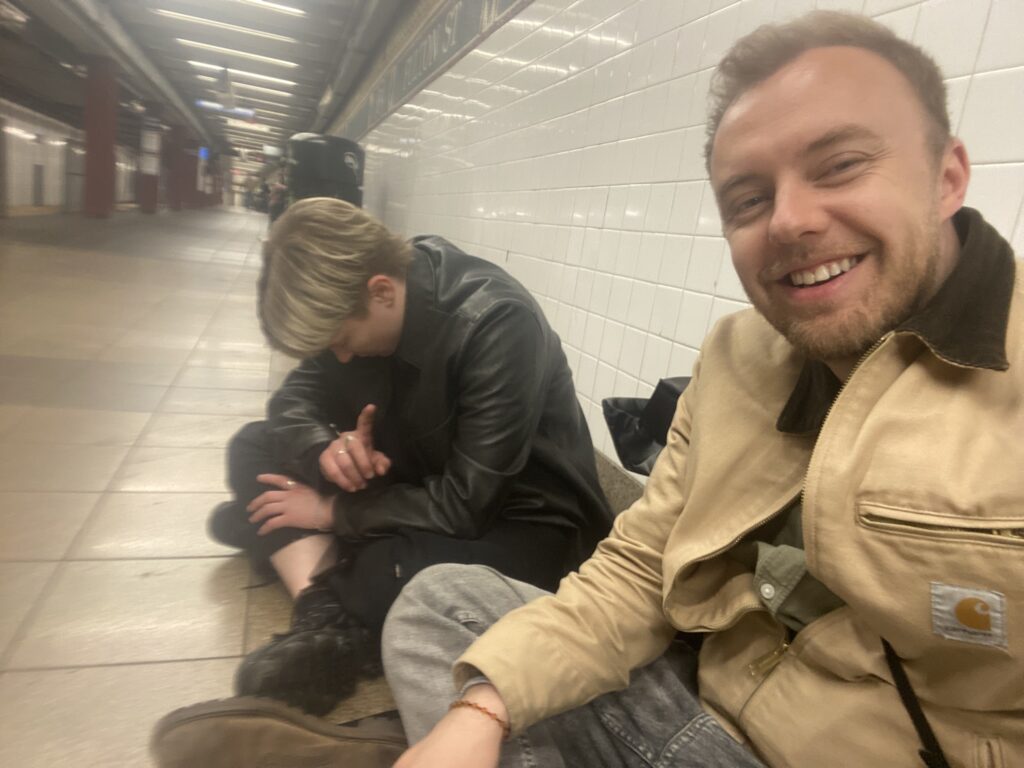
We took the subway home after – once again, ships in the night, as I rallied and suddenly felt rather light and marvellous, while Annie crashed and lost the ability to form a coherent thought. Sometimes over the years, if I’m really enjoying a conversation or I’m finding something insightful or amusing, I take out my phone and subtly record the audio. I’ve recorded our chats a few times – usually so I can either record the wonderful stuff Annie’s saying, or wind her up. Here’s the transcript of Annie and I, worn out and slowly going insane as we sat on the train home.
Me: Alright. I’m not recording.
Annie: No you’re n– you stupid… Alright so Fulton… two gates… now we’re at Kosciuszko.
Me: It’s one more stop.
Annie: Yeah we’re actually super close.
Me: So what were you saying about GTA? They made it less sexy?
Annie: GTA is amazing and it’s a…it’s a fucking archetype for the, uh, the idealistic forms of video games most people are looking for. It’s not supposed to be a peaceful environment, it’s supposed to be a bit chaotic.
Me: But we were talking about, it’s – I said it’s gonna be based in – GTA 4 is based in New York. And you said it’s not.
Annie: No because it’s already, uh, Liberty City is based in New York. GTA 3 is based in New York.
Me: Yeah but 4 is also. So they had Vice City, San Andreas in other places. Vice City is like Miami. San Andreas is like, uh–
Annie: I thought Vice City was like the main one. And it changed.
Me: What does that mean?
Annie: They changed… they changed after Vice City. Like, did they take Vice City and turn it into something bigger? I always thought that it was like, Vice City was the main thing. So you’re there. And everything else kind of changes over time.
Me: What do you mean over time? What does that mean?
Annie: It chan– changes over time. Changes as like, new people get on board, new people get hired. The game continues as people start to sign on, get to– get to work on it. You know what I mean?
Me: And then what, the physical geography of it changes as well? Because of new–
Annie: Yeah I think so, that’s what I was wondering. I was like, are people who work there, are they still in England or are they somewhere else?
Me: Were you wondering that?
Annie: Yeah a little – a little bit yeah. Kinda… kinda curious. Like where… where the fuck are they? Why are they, uh, why are they so fucking far away, you know? Why not… why not just come back? Make it all jolly.
Me: Yeah. Why not just come back and make it all jolly?
Annie: Make it all jolly and good, these fucking lunatics.
Me: [beat] That’s crazy man. You’re crazy.
Annie: It isn’t cra– no you– you’re crazy man. You’re fucking crazy man.
And well — that’s why I like her.